
Is it the destiny of all large companies to ossify?

Is it the destiny of all big companies to ossify?
I first started thinking about this in 2003 when I started working for Ford Motor Company. At the time, that company had over 300,000 employees - enormous! I noticed a lot of “big company” things that slowed progress. Rules, policies, procedures. A lot of it felt like the movie “Office Space” and TPS reports.
For example, if I had to move desk locations, I wasn’t allowed to bring my computer and material from one desk to the next. I had to box it up, label it, and wait for other people to come move it - even if the desk was literally down the hall!
Not having worked elsewhere, but having seen enough movies and read enough Dilbert, I got curious. Is it inevitable that as companies grow, they get stuck? They become rigid, inflexible, and unfeeling? Or can they retain their youthful dynamism as they grow?
You may have observed this big-company-rigidity play out at large tech companies during layoffs. They often notify affected staff through email or a pre-recorded video, followed by same-day offboarding.
At large scale, operating choices tilt from bespoke, high-touch processes toward standardized, low-variance ones - they’re often faster and safer for the business, but are experienced very differently by employees.
So is it the destiny of all companies to ossify as they grow, or is there an antidote? Let’s explore!
What ossification looks like
One of the best ways to see ossification at work is to spend time with its opposite. If you’ve only ever been with a large company, I encourage you to find people at a really small company and share notes. Ask them how x, y, or z thing is done at their company. The contrast is really stark!
If you’ve only been with a small company, seek out your big company counterpart and do the same exercise.
If you’ve never seen big companies at work, here are a few symptoms.
One way in which this shows itself is in a lack of creative destruction. Large companies can milk what makes them money today versus thinking of what will make them money in the future. They exploit rather than explore. They stop experimenting.
Another way you see this is that large companies are slow in decision making. Sometimes it’s slow because decisions are pushed up to a big leader, which adds time. Other times it’s because of a drive for consensus and fear of failure, so a decision maker waits for a consensus to develop before being willing to make a call.
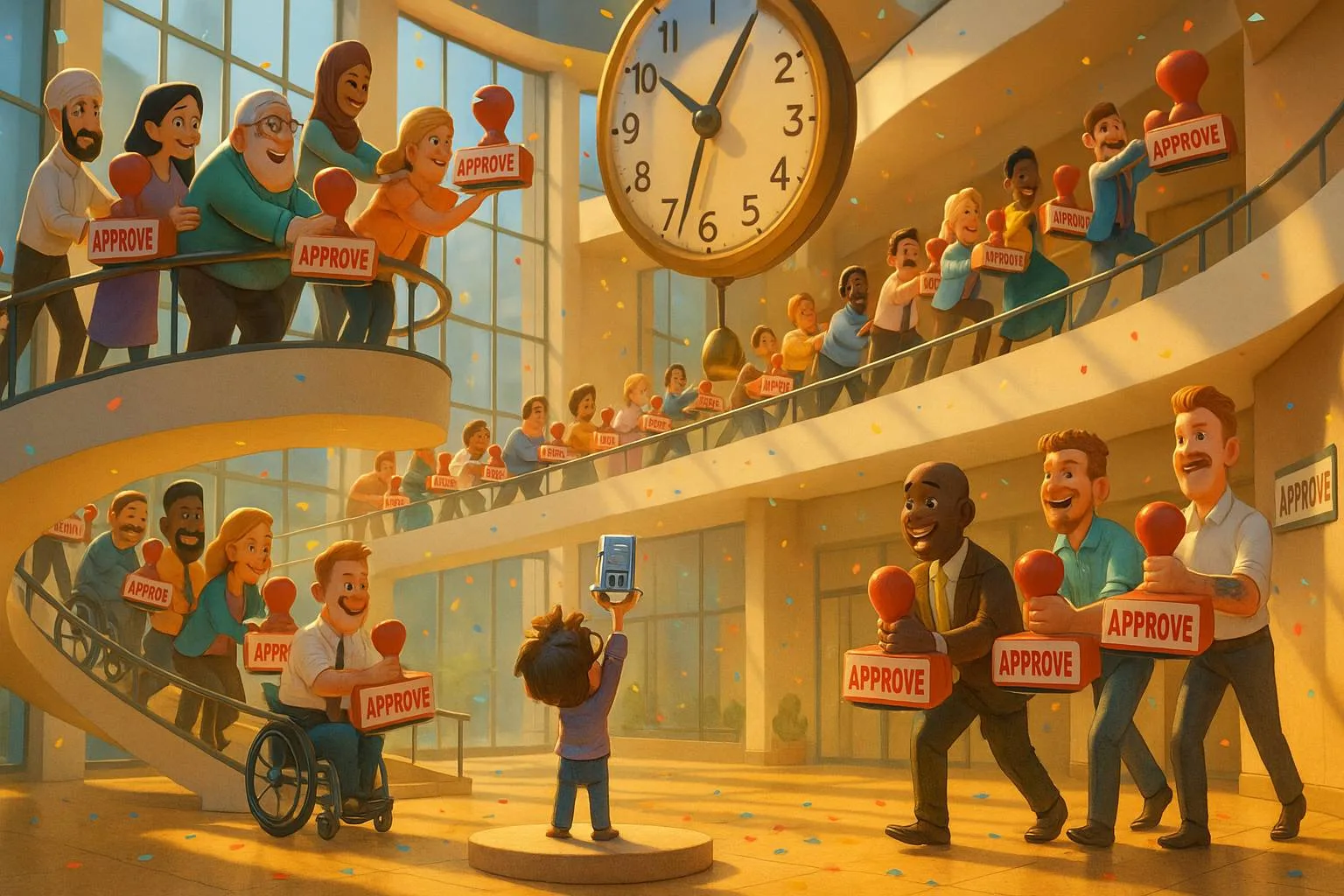
A huge indicator is policy over people. Policies don’t handle edge cases well. Human judgment is lost, and you fall back on whatever the policy says. Any time you’ve heard a customer service representative say, “Sorry, that’s the policy,” you’ve experienced this issue.
Another symptom is meeting obesity; meetings that go on too long, with too many people. The classic joke is there for a reason; large companies are well known for having meetings to prepare for meetings.
The last symptom I’ll talk about is cross-team friction. It can be really hard to get work done with others in a large company. If two people or multiple teams need to work together you have to escalate up their respective management chains to resolve resourcing before the teams can actually work together.
I could go on for a while, but I think you get it by now 🙂 These may be the symptoms, but why does this happen?
Why do companies ossify?
One key insight I got for this comes from the book “Loonshots” by Safi Bahcall. In that book he talks about how incentives begin to shift - coincidentally right around Dunbar’s number - from favoring business outcomes to favoring careers.
Essentially, what begins to matter more is whether your boss is happy, not whether you’re achieving business goals. In a small company, those things are usually one and the same. Your boss is happy when you’re hitting business goals because you’ll all go out of business if you don’t.
For a larger company, those two things can start to drift - what makes your boss happy may not be the best thing for the business. These misaligned incentives can cause a lot of the bad outcomes.
“For typical real-world values of the control parameters there is, in fact, a sudden change in incentives around the magic number 150. At that size, the balance of forces in the tug-of-war changes, and the system suddenly snaps from favoring a focus on loonshots to a focus on careers.”
— Safi Bahcall in “Loonshots”
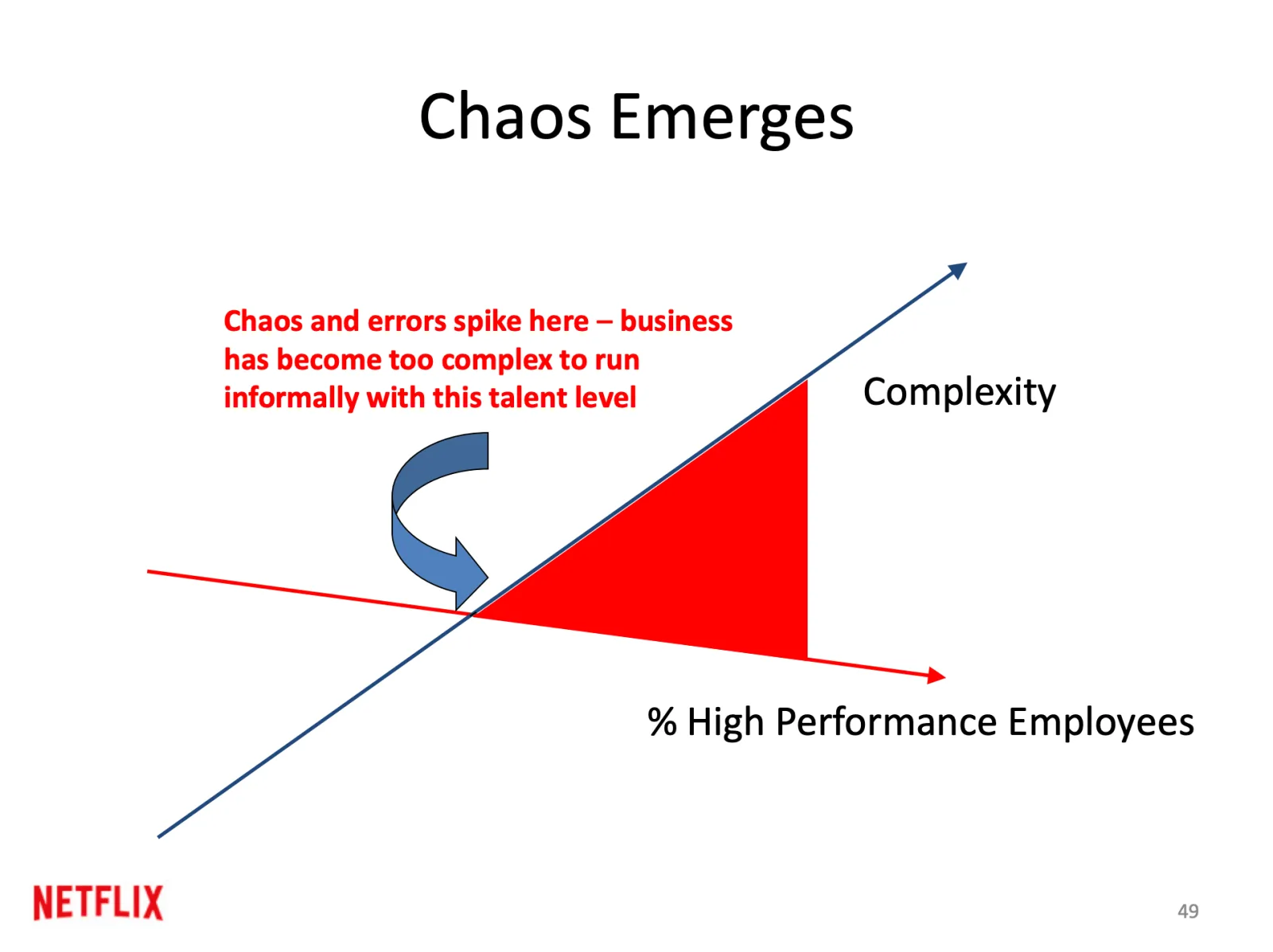
Another insight comes from Netflix’s famed culture deck related to talent density. They purport that as businesses increase in size, so does complexity. Also, because there are only so many amazing employees, talent density tends to come down as you grow in size.
The gap between high complexity and low talent density results in chaos, which is often filled with policies and procedures to combat it. These policies and procedures tend to drive out high performers, lowering talent density even further, driving more policies and procedures - and the cycle continues.
The quote below from Stephen Bungay in “The Art of Action” is long, but perfectly encapsulates what’s going on.
“In an attempt to cope with the complexity the organization grows complex as well. It becomes opaque, which creates internal uncertainty to add to the uncertainty outside. Different parts of the organization are concerned with different things and seek to do a good job by optimizing them. The results clash. Faced with uncertainty, people search for more information; faced with complexity, they do more analysis. Meetings proliferate and decisions are delayed. People in the front line become frustrated at the lack of the decisions they need someone to make to let them get on with their job, and people at the top become frustrated at the apparent lack of action, although the level of activity is high. More initiatives are launched, increasing the level of activity. The psychological effect is to increase confusion. There is lots to do, but what will have the greatest effect and who should do it? Accountability becomes more diffuse, so controls proliferate. This slows things down and restricts the scope for front-line decision making. In an attempt to increase clarity, actions are specified in more detail. The emotional effect is an increase in cynicism and frustration. Trust erodes. The cycle is toxic.” - Stephen Bungay in “The Art of Action”
Org. structure also comes into this. Large companies tend to design around centralized functions because they think they get economies of scale (e.g. there’s a single data engineering org, or a single product management org.). But this comes at the cost of business acumen and speed.
It seems like it’s not inevitable that companies will become rigid as they grow in size. Are there any businesses that can serve as counter-examples?
Large companies with youthful flexibility
I can’t speak first hand, but from my reading it seems like there might be a few businesses that stay flexible as they grow large.
Netflix is one that comes to mind. Reading their current careers and culture page, and you’ll see a lot of language about speed. And not just language, but practical examples of how they run internally, like this quote about “informed captains.”
We avoid decision-making by committee, which tends to slow companies down and undermine accountability. For every significant decision, we identify an informed captain who’s responsible for making a judgment call on the right way ahead. Then different teams, each led by their own informed captain, implement the decision. This highly aligned and loosely coupled approach gives teams the freedom to move quickly and operate independently, while ensuring responsibility for the outcome.
I think Microsoft under Satya Nadella (not under Balmer) is another good example. They have over 200K employees today, which is extremely large. But in reading his book, “Hit Refresh” and seeing their market performance, it makes me think he’s been able to implement improvements to keep things supple internally.
“Our culture had been rigid. Each employee had to prove to everyone that he or she knew it all and was the smartest person in the room. Accountability—delivering on time and hitting numbers—trumped everything. Meetings were formal. Everything had to be planned in perfect detail before the meeting. And it was hard to do a skip-level meeting. If a senior leader wanted to tap the energy and creativity of someone lower down in the organization, she or he needed to invite that person’s boss, and so on. Hierarchy and pecking order had taken control, and spontaneity and creativity had suffered as a result.”
— Satya Nadella in “Hit Refresh,” talking about the Microsoft culture he was trying to fix
For a long time I was going to suggest Amazon was a good counter-example (1.5M employees - mind-bogglingly large), but lately I’m not so sure. My original rationale for inclusion was the extensive writing of Jeff Bezos - his “Day 1” thinking and focus on speed seems like exactly the kind of thing that would prevent that company from ossifying.
But with Andy Jassy at the helm, and things like their handling of a Return to Office (RTO) mandate (aka policy) makes me think it’s not as supple as it might’ve been under Bezos.
I’m sure there are a lot of examples of companies that are doing well that I’ve never heard of. If you work for a company that you think is a great place to work and is doing well to avoid the large company fate, please let me know.
How to keep things loose as your company gets bigger
It’s better to prevent yourself from ossifying than to try to fix it once it’s happened. With that in mind, here are a few things that can help along the way.
When it comes to org. design, my personal opinion is that the economies of scale for centralized functions are never realized - and if they are, they don’t counteract the downsides elsewhere. Most companies would do better to keep smaller decentralized teams.
Companies and teams should practice what I call “business autophagy:” Kill off policies, procedures, products, and anything else that isn’t appropriate any longer. For example, just because you can report on 100 metrics doesn’t mean that you should. A former colleague of mine at Atlassian introduced me to something she called “kill a stupid rule,” and I loved it. It was an intentional practice to get a bottoms-up perspective on what was no longer working so we could investigate and kill it. Do that proactively.

Have an external enemy. You need something to fight against to keep your org’s fitness. Make sure you have someone or something that you’re striving against. Steel sharpens steel.
Develop psychological safety - specifically challenger safety. You need your team to feel comfortable challenging the way things are, which will not happen if you don’t have sufficient safety.
Encourage experimentation and crazy ideas. Keep things fresh. Try to disrupt yourself before others do it for you.
Lastly, keep your decision-making speed high. Be comfortable with ‘failure’ and your ability to pivot. Move authority to information. Most decisions are two-way doors anyway, so there’s no reason to go so slow! You often waste more time prepping and planning than you would just getting started and adjusting if you’re wrong.
Is it the destiny of all companies to ossify as they grow large? What’s your assessment?
I think it’s not inevitable, but avoiding it is really really hard. There’s a lot that goes against human nature. We’re tribal people, and as Safi Bahcall’s research shows, above 150 people those incentives start to switch. And 150 people isn’t large!
Even if it’s hard, it’s worth it for us as leaders to try. We’ll be happier in those environments, and our people will flourish more than in the alternative.
Call to Action
No matter where you work, you’ve got a role to play in preventing the ossification of your company.
Not every collection of humans is going to avoid this fate, but the more you’re aware of the milestones along the way, and best practices to avoid it, the more likely you are to delay or avoid that outcome.
Take a look at the section above for how to keep things loose and assess your team against them. How close or far are you from challenger safety? How’s the culture of experimentation? How slow is your decision making?
Pick one thing, no matter how small, to improve this week. Delegate a decision or make a call. Run an experiment. Kill a stupid rule. Your customers and employees will appreciate the effort.
Kevin
PS - If you’ve got anecdotes and experiences related to today’s newsletter, I’d love to hear them as part of my ongoing research. Please share your thoughts with me at kevin@catalyst.group18.co. Thanks!