
Too Tough or Too Tender? Find the Mean

Have you ever take care of plants?
For some reason watering is hard for me. Whenever I look up what might be wrong with a plant that’s struggling, it says I’m either watering too much, or not enough.
Well, which is it?!
Eventually, after enough trial and error, I find the right amount of watering for a plant. Feeling confident, I buy another one. I employ the same successful watering schedule, and…the new plant struggles.

Aristotle wrote about this in 350 BC. Well, not watering plants per se, but close: Moral virtue.
In a series of books called the Nicomachean Ethics Aristotle explored the idea of golden mean, which he defined as virtue sitting between two vices - one of deficiency, and one of excess.
The central principle is one of balance. You can’t go to either extreme, but have to find an effective point in between them.
Even though these books were written 2400 years ago, the ideas are surprisingly applicable to us as leaders today!
Aristotle’s Golden Mean
Aristotle’s view was that there is an ideal middle point between extremes that represented virtue. Golden comes from the idea that this was highly valued, and Mean comes from the idea that it’s in the middle (like an average).
The table below (from source) shows several good examples of virtues that sit in between vices. Courage is the classic example. Too little and you’re a coward. Too much and you’re rash.
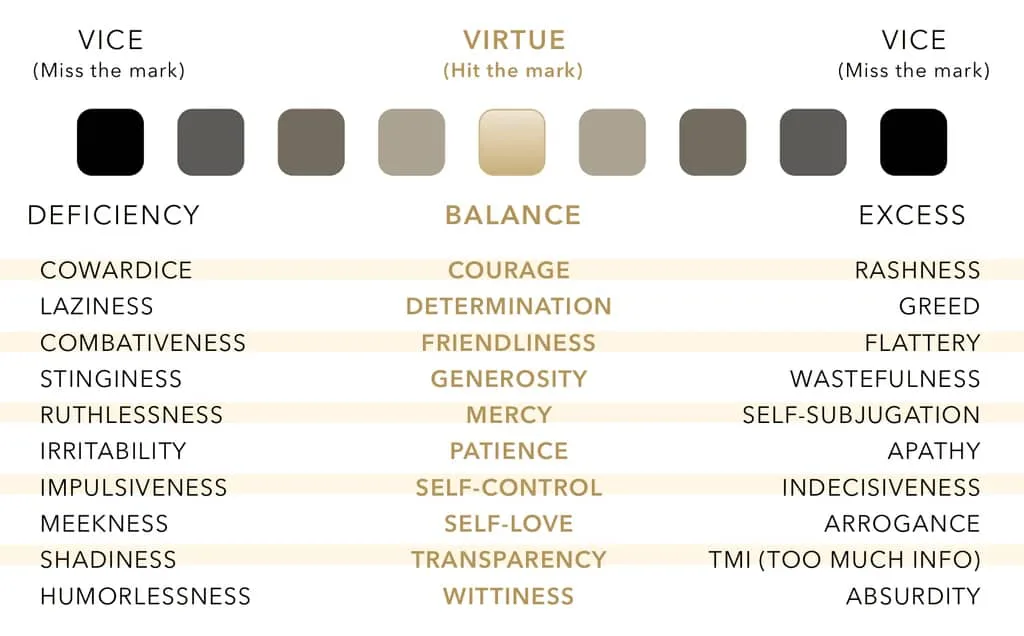
Although Aristotle was speaking to moral virtue, we can apply this to leadership behaviors. You can be “too much” or “not enough” of something as a leader.
If you think being friendly is good, and therefor treat every employee like they’re your best friend from college, you can create negative outcomes - even though you think you’re doing the right thing.
One interesting observation is that the Golden Mean is not a static mathematical determination. Virtue is relative to this person, this role, this situation.
This connects to my “sliders model,” where leaders need to adjust their approach in every situation. Who’s in the meeting? What’s the market environment? How much risk is present?
Let’s use transparency as an example. If you don’t share any information, your team doesn’t have the right context to be successful. If you’re too transparent, you might demotivate, or you might confuse.
Unfortunately there is no “right” amount of transparency. The people matter: some don’t get confused as easily, some don’t want more context. The situation matters: there might be too much risk in sharing, or there may not be enough time.
Another observation was that virtue is formed by action. Knowing the ideal doesn’t matter; acting consistent with it is. And since it’s something that’s situation-dependent, you need experience in different situations to develop the intuition to know where the mean lies.
It’s an argument for putting yourself out there and trying. Practice your leadership behaviors!
You’ll get it wrong - too strict or not strict enough, over/under sharing, etc. - but each time you fail, reflect, and adjust you’re getting closer to the Golden Mean.
Modern Leadership Examples
There’s a short list of virtues that Aristotle studied, but there are hundreds of leadership behaviors that could be analyzed! I had a lot of fun putting this table together, but it only scratches the surface.
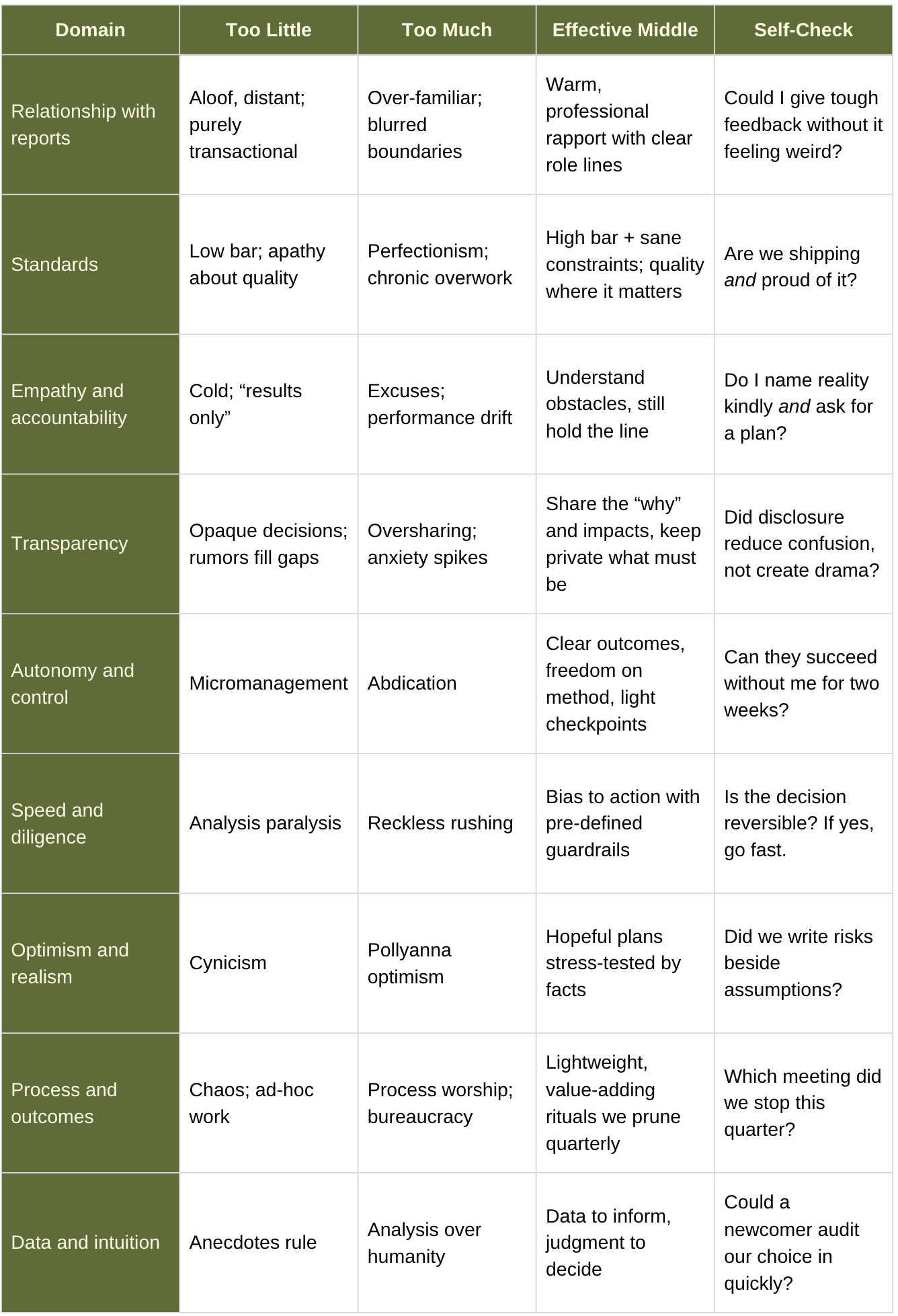
As leaders we all have our personal values that can drive biases towards different ends of the spectrum. I value integrity and honesty, so I bias towards too much transparency. In excess, I’ve seen the confusion on people’s faces, and I’ve seen the demotivation when I share my true feelings about a plan of action.
When you get the balance right, it’s amazing. I’ve seen the spark when the additional context locks in someone’s understanding of a complex subject. I’ve seen teams operate more independently when they have all the information they need.
I’m still learning how to be true to my values and understand the impact it can have on people. How much transparency is right for this moment?
Jocko Willink and Leif Babin wrote a great book exploring this topic of balance, called “The Dichotomy of Leadership.” I recommend it if you want to explore this idea further.
“Some leaders took this too far and became humble to a fault. But being too humble can be equally disastrous for the team. A leader cannot be passive. When it truly matters, leaders must be willing to push back, voice their concerns, stand up for the good of their team, and provide feedback up the chain against a direction or strategy they know will endanger the team or harm the strategic mission.”
— Jocko Willink and Leif Babin in “The Dichotomy of Leadership”
It’s all well and good to know there’s some sort of ideal middle ground balanced between extremes - but how do we find it?
How to Find the Mean
There’s an abstract approach, independent of whatever virtue of behavior you’re trying to find the mean for, that you can apply. It’ll be a faster than just sort of hoping that you’ll get better through time and experience.
The steps are:
1 - Name the poles: What’s excess and deficiency?
2 - Set guardrails: Decide on your non-negotiable items (things like budget, timeline, safety, ethics).
3 - Monitor indicators: Signals that you’re drifting.
4 - Run experiments: Have a hypothesis and try it out.
5 - Learn and adjust: Retro on what worked and what didn’t, then make a small change.
Using a practical example from autonomy and control, let’s walk through what those steps might look like.
1 - We have micromanagement on one end, and abdication on the other.
2 - Three months to achieve our outcome, and I won’t compromise ethics.
3 - I’ll monitor missed SLAs and sentiment drop in the team.
4 - For two sprints I’ll check in less frequently and request video demos.
5 - I’ll do a retro one month in and tweak if things are going in the wrong direction.
You can play around with these steps for whatever you’re working on. The idea is to map the space (naming the extremes), then be intentional about where you want to be, taking feedback and adjusting along the way.
This type of intentional approach to your development will help you improve very quickly. You’ll also become much more aware of your biases and values as you try to figure out why you tend to be one way versus another. Self-awareness is the first step in trying to change anything.
Call to Action
What feedback have you received recently? Are you too much of something? Are you showing an insufficient amount of something?
Spend this week being intentional about that behavior. Name the extremes and imagine what your behavior would look like on either end.
Set up a little experiment for yourself and start giving it a try. At the end of the week, do a little retro and see how you feel. Was it more effective? What’s the feedback from your team?
Good luck and have fun!
Kevin 🤗