A good friend, Nick, who I have worked with before has now joined Group 18, bringing the team up to four contractors plus me. It’s feeling lively! He’s got a great, broad, skill set that’s very helpful.
Recently Nick, Anna, and I had a little one day offsite at my house that was a lot of fun.
I went to the office supply store and the grocery store to get Sharpies, a big paper easel, post-it notes, and snacks. None of that was required, but I think it made it more enjoyable. I don’t have a huge whiteboard in my house, so the tear-off paper easel and Sharpies were a good replacement for sketching out thoughts throughout the day.
One area of focus at the offsite related to me decreasing my own service delivery time. If I’m serving today’s clients, then I’m not finding tomorrow’s clients. And tomorrow’s clients are needed so that I’m creating enough load to support full time W-2 staff (a goal for 2026). Having Nick and Anna here makes that easier to do; they’re senior enough and have the right characteristics that they can take ownership of big outcomes.
I’ll use the time I unlock to support Ken, my sales contractor, with collateral, strategy, client conversations, or whatever else he needs.
Remember Ollama, the open source private LLM application you run on your computer? It was great at doing its core job (private use of AI), but the UI left a lot to be desired because you had to chat via a terminal interface.
Apparently this changed mid-2025; they have created a slick chat interface – the kind you’re used to on ChatGPT or Claude. Down in the bottom right of the chat window you select your LLM and chat like normal. It looks exactly like ChatGPT.
I’ve been using this much more now that the friction is lower. I use it for quick questions that I don’t want cluttering up the sidebar of other tools, and I use it when there’s no internet connection (like air travel). I haven’t done it yet, but in theory this is much better for things like health questions or other private things you may not want sitting on someone else’s servers (your Ollama chats stay on your computer).
If you’ve been on the fence on Ollama because it seemed hard to use, give it a try now – it’s essentially the same as any other app.
Kevin
A Quote
“
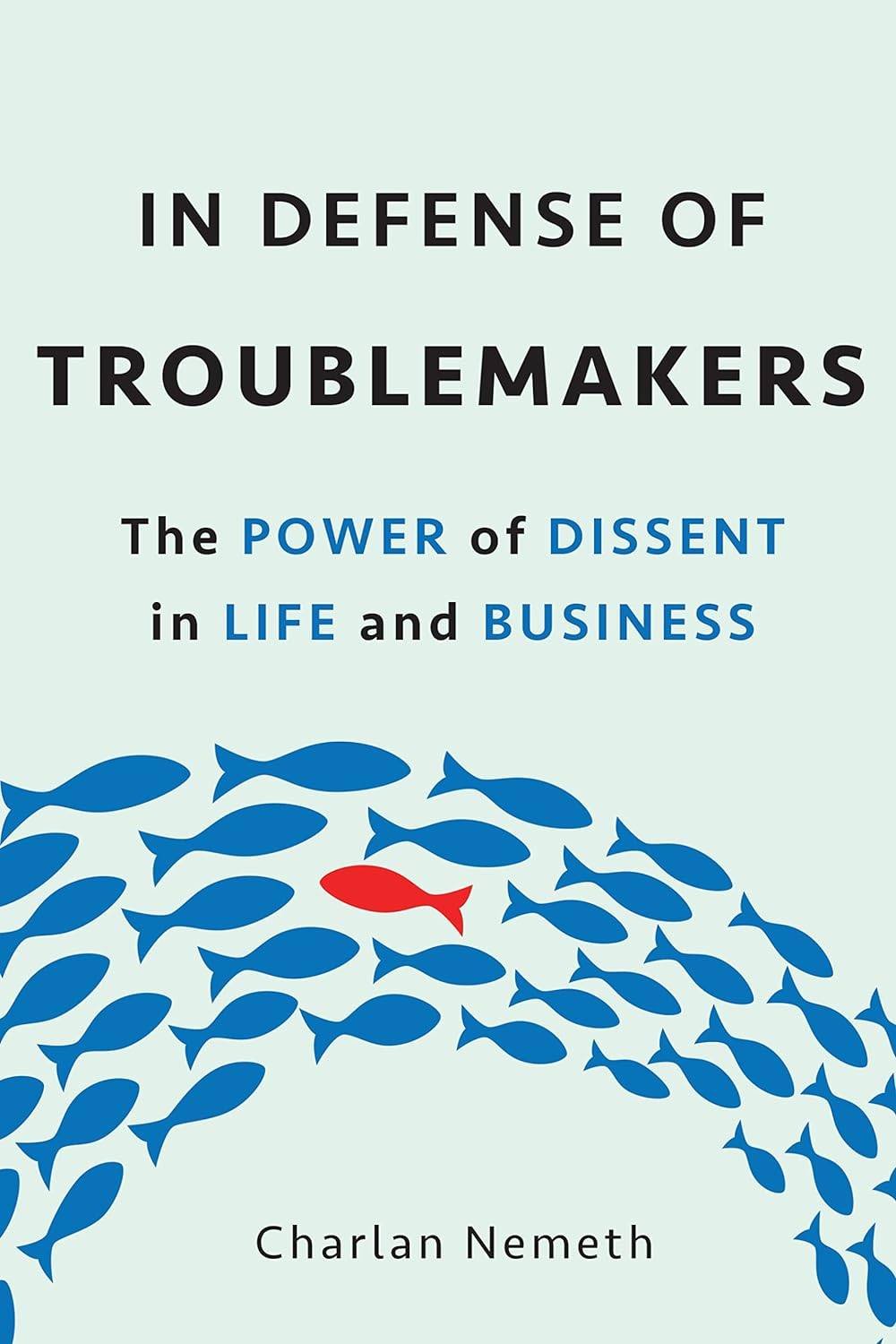
It is not the presence of demographic diversity, nor even just the presence of opinion diversity, that favors good decision-making. It is challenge. When competing and authentically held views are expressed, our thinking and decision-making benefit.
Here’s a pre-order for a cool hardware device called the Busy Bar ($200). Lots of different ways to program it. I could see myself using it to start a timer when I’m tracking billable work. I could also see hanging it above the door to my office to indicate to my family when I’m on a call. Of course, at $200, those uses may remain in my imagination.
I was looking up ways to cook a rib roast and found this video by Alton Brown. He has interesting techniques, and he has an entertaining way of explaining them. Now I want a massive blow torch to sear meat. 🔥
Over Christmas there was a lot of ballet in my life. At the beginning of The Nutcracker there was a slide on the screen saying how many shoes the ballet performers go through, and it seemed crazy – like one per day? I was curious and ended up on this video that taught me more about pointe shoes. These shoes are still made mostly by hand, and the dancers tear them up before using them.
(Enjoy this 5️⃣ minute read)
Deep Dive on Containment and Structure
When business problem solving feels chaotic, the instinct is usually to slow down. To think harder. To try again.
Sometimes those techniques work, but often there’s a different approach needed.
What’s missing isn’t usually insight or effort. Teams don’t need more time, or even to communicate their ideas more clearly.
What’s often going on is that the chaos is caused by things not having a home, or those things lacking structure.
Leaders who understand these dual root causes, and who can deploy interventions, will save a lot of headaches for themselves and the team.
The First Problem: Things Without a Home
Ideas come up in meetings and disappear. Errors get noticed but never written down. Tasks get mentioned, but they don’t get done.
You get burned by a risk on a project, but you know you and the team talked about it three months ago. What happened?!
It didn’t get documented. It didn’t get put in its home. It wasn’t put into a system where it could be processed.
Everything needs a home. It needs to be contained.
When something doesn’t have a place to land, it floats. And floating things consume attention out of proportion to their importance.
All these great ideas are going to float away if they don’t get contained.
People don’t need everything solved immediately.
They need to know it’s being held somewhere other than their head. They need to know that it’s being put into the system.
This is why simple things work: – A “parking lot” for ideas that come up during an offsite. – Error logs – Risk registers – Task lists
If this problem doesn’t resonate yet, try it yourself. Brainstorm the top 10 things you need to do today, but don’t write them down – keep them in your head. At the end of the day, how many got done? How often did you think about the list during the day? Were you stressed?
On the next day, brainstorm again, but this time write them down. How does that feel? I bet it feels great. You don’t need to remember. All that cognitive load is freed up to focus on the task at hand.
The Second Problem: Things Lack Structure
This problem is subtler. It’s about orientation and architecture.
Or it’s like the old “joke” about three blind men touching different parts of an elephant. They’re all talking about the same thing, but are describing it differently. It feels like disagreement, but in practice they’re all talking about different elements of the same object.
This failure mode often looks like a conversation that feels tangled. You’re sort of talking about the same thing, but not quite. It’s not resonating. People are talking past each other. Things get tense.
Let me illustrate this one with an example.
A Two Short Examples
I was on a recent call where a team was deep in a technical and project discussion.
It started off well. Ideas were flying. I could see the merits in each suggestion and how they fit together. But pretty soon the conversation got tangled and tense. I could see people getting confused and frustrated.
Then it dawned on me. Not everyone was using the same mental map I was. I saw how some things were short-term versus long-term (sequencing). I saw how some things were quick fixes versus features versus architecture. And then there was another layer of which problem was being addressed by the suggestion, which further complicated things.
So I paused the conversation to zoom out and share the map.
I said, “I think we’re actually all in agreement. Here’s how I see it.” And then I said we’ve got three buckets; fixes to the existing product that we need to get out ASAP, new features for the existing product we need to ship next week, and finally, changes to the architecture to make this problem easier to solve for future clients.
I pointed out how one person was talking about solving problem A with a quick fix, and doing so immediately. I pointed out how another person was talking about fixing problem B with a new feature next week. I showed how everyone’s points fit on the map.
Once I did that, everyone realized they were in agreement. The conversation ended and everyone got into action mode. Less time arguing, more time solving customer pain.
Structure creates clarity.
As a bonus example, I was on another call solving a different problem. Everyone on the call had a different role, so everyone saw the root cause of the problem differently. Pretty soon the conversation became a debate; one problem versus another.
But actually, ALL of the factors were contributing to the problem. It was an AND, not an OR. These problems were not mutually exclusive where only one could exist. There are pricing issues to look at, and there are execution problems to look at, and there are capacity problems to look at.
All I did was share the three buckets and point out how they will each need to be addressed. Now everyone realized it wasn’t an argument. Their point had been made and recorded. We could move forward into solving them.
Placement and Structure Change the Nature of Conversation
Giving things a home, and giving things structure, are two powerful leadership moves to untangle complicated problems and conversations.
This is especially true in modern remote work with Zoom meetings. It’s common for everything to stay in the mental / verbal realm. People try their best to remember the issues and ideas, and they try to communicate how they see the world through language.
But memories and language are imperfect. Everyone has different experiences and biases. We need another approach.
Instead of saying the same thing harder, we make sure everything has a home and we create structure. That done, people can more easily interact with the system and see how the pieces fit together.
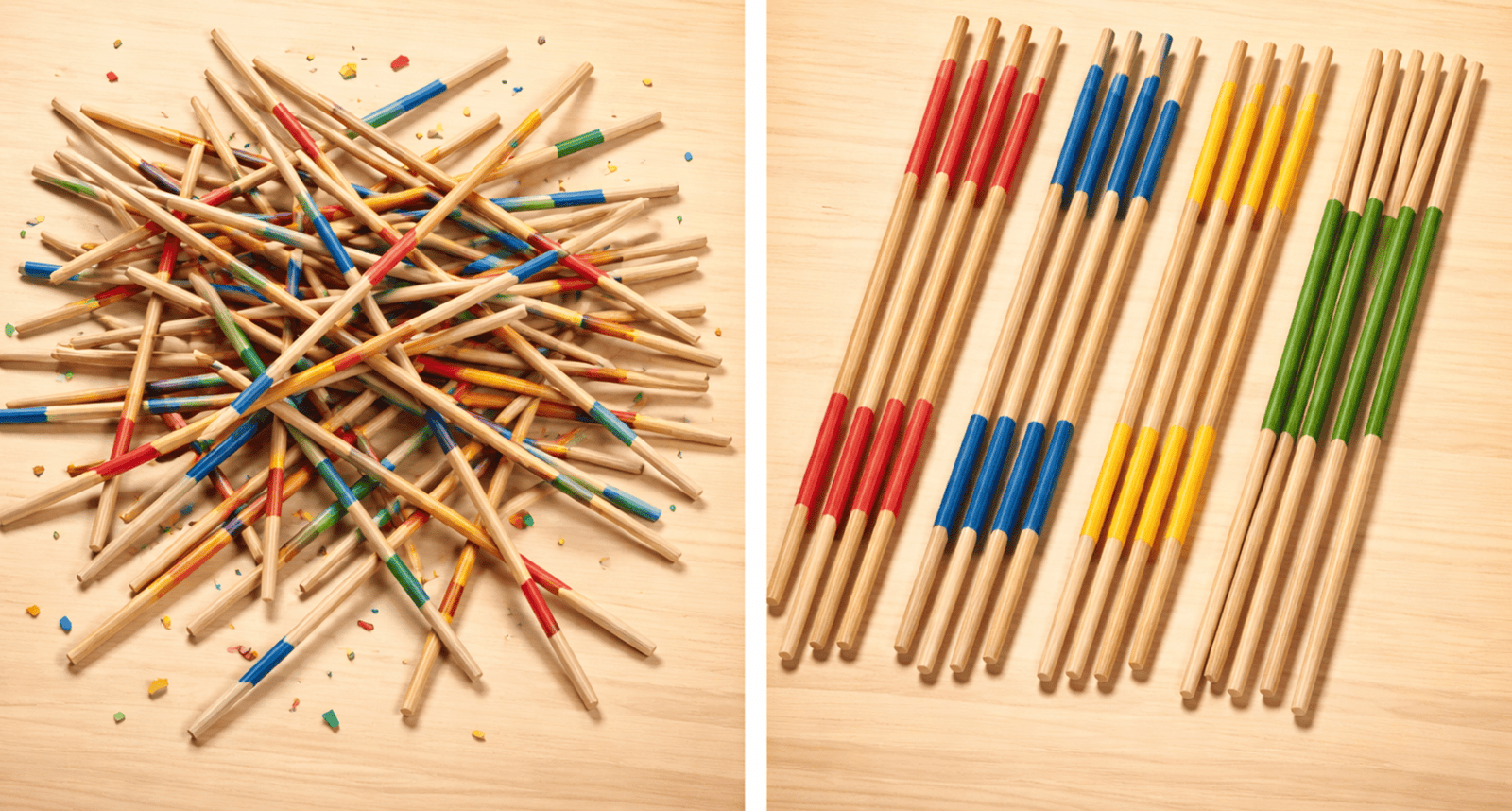
Containment solves: “Does this have a home?” Structure solves: “How does this fit in relation to everything else?”
Good leaders do both, and usually in that order. Contain what’s floating. Orient what’s tangled.
If you skip containment people get anxious. If you skip structure people get confused.
Where This Breaks
Like most things, you can get this move wrong. And it usually relates to ownership and forward action.
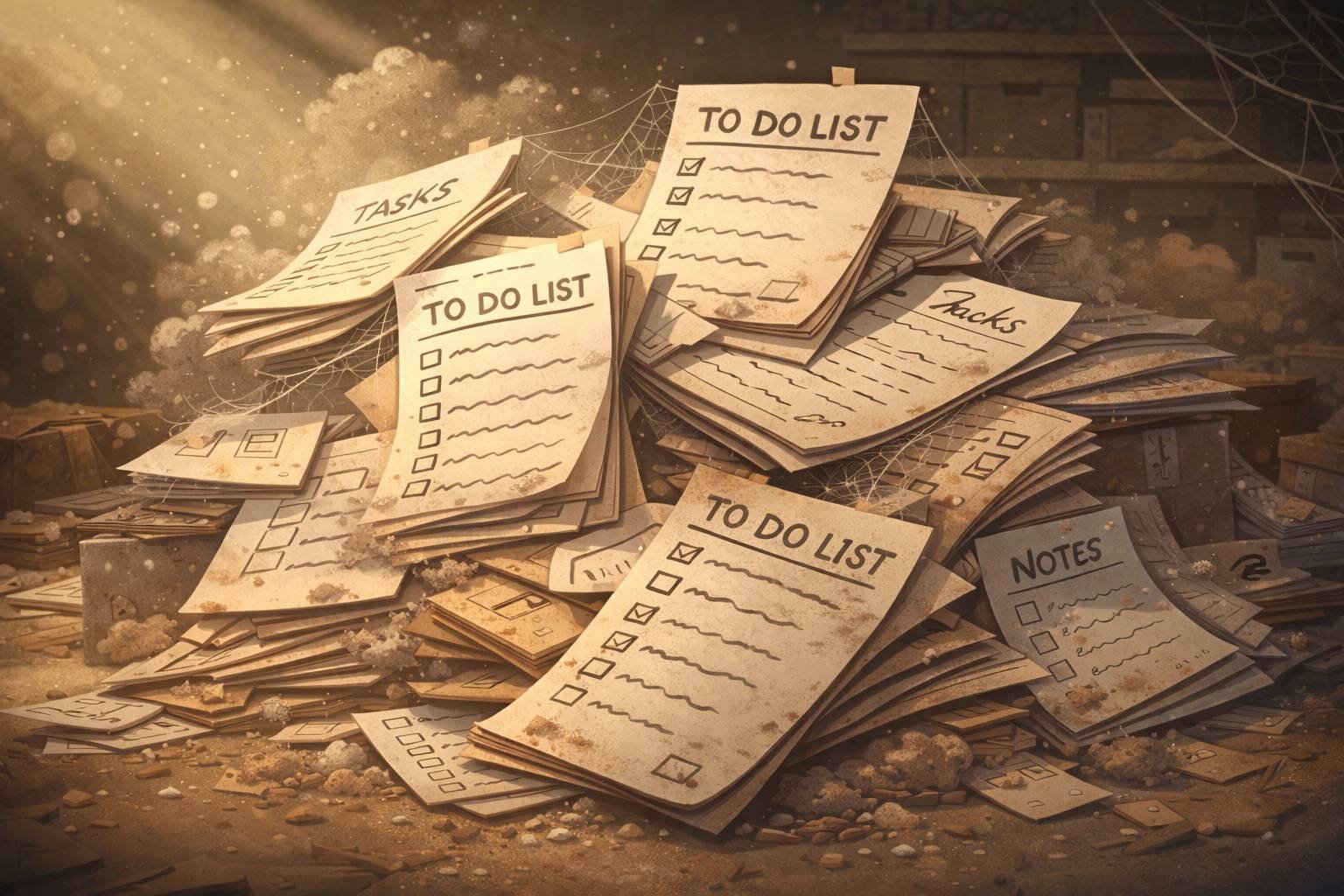
If you’re putting things in a home, but that home isn’t part of a system, or no one owns resolution, then the home is just a dumping ground and things don’t get resolved.
An unused and unloved pile of things that were given a home.
If you write your task list on a piece of paper, but you actually manage your day on your computer and never look at the list, you didn’t really solve a problem.
On the structure side, if you’re constantly debating the map and the architecture, but nothing is getting done, then it remains an academic exercise.
The point of structure is to create clarity and forward progress.
The Question to Ask
When things feel noisy or tense, I don’t ask: – What’s right? – Which thing should we prioritize? – Who is wrong?
I ask: Is there anything floating? Are we all touching different parts of the elephant?
Some things need a place to land. Others need a map.
Both are excellent leadership moves.
Call to Action
Be sensitive this week; look for people feeling anxious or confused.
Look for floaters. Are there ideas, risks, tasks, or other elements floating without a home? If so, give them one. Even if it’s just a list where everyone can see it, that works.
If there are no floaters, check if everyone sees the same map. If people are confused, see if you can create structure. Even naming groups of things (like in my examples above) can be a form of structure.






Comments are closed